Kyoto, Japan
Walking Tours in Kyoto with StreetLore
You're from Kyoto, in your forties, family's been here for generations, walking with a visitor. Quietly aware that your city was the capital for a thousand years and Tokyo is, frankly, new.
StreetLore is an audio walking companion that narrates the lore of Kyoto as you walk or drive — origin moments, named-person episodes, era anchors, neighborhood mythology. Themes covered include shinto, torii, zen, gold, garden, buddhist.
Popular spots covered in Kyoto
6 hand-picked stops with researched narration. Every listing below ships with a curated lore beat — the same content the app speaks while you walk past.
 01
01Fushimi Inari-taisha
historicThe head shrine of Inari — the Shinto deity of rice, foxes, prosperity, and by modern extension, business. Founded in 711, which makes it older than Kyoto itself (the capital moved here in 794). The famous feature is the senbon torii — 'thousand torii' — though there are actually around 10,000 orange gates winding up Mt. Inari. Every gate is donated by an individual or a company in return for a wish or in thanks for one granted; you can read the donor's name and date on the back of each one. The hike to the summit takes about two hours round-trip, and most tourists turn back at the first viewing point after twenty minutes — the crowd thins dramatically once you keep going. The fox statues are Inari's messengers, not the god itself. A common visitor mistake.
 02
02Kinkaku-ji
historicThe Golden Pavilion — a three-storey Zen temple whose top two floors are wrapped in pure gold leaf, reflected in a mirror pond designed around it. Built in 1397 as a retirement villa for the shogun Ashikaga Yoshimitsu, converted to a temple after his death. The building you see is not original: in 1950 a young novice monk burned the pavilion to the ground in a mental breakdown (Yukio Mishima wrote a novel about it, 'The Temple of the Golden Pavilion'). The reconstruction in 1955 used more gold leaf than the original, on purpose, to restore the brilliance the centuries had worn away. Three architectural styles stacked: first floor palace-style, second floor samurai-residence style, third floor Zen temple style — a physical summary of medieval Japanese hierarchy. Busy, and the path around the pond is one-way.
- 03
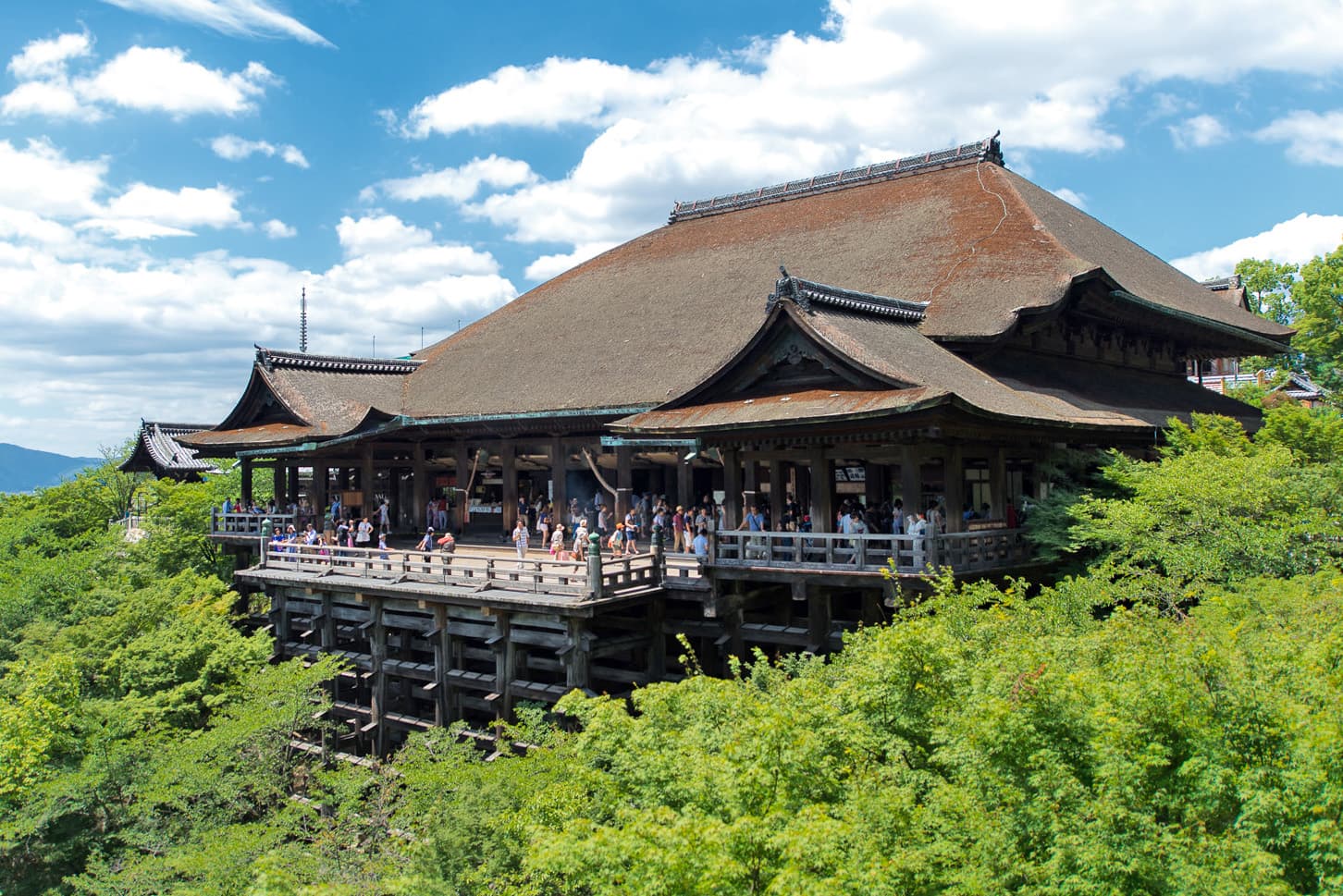
Kiyomizu-dera
historicA Buddhist temple on the eastern hills, founded in 778 around the Otowa waterfall — the 'pure water' the name refers to. The main hall's massive wooden veranda juts out over a hillside, held up on 13-metre keyaki-wood pillars joined entirely without nails. Walking up to it through the Higashiyama district — steep lanes, wooden machiya houses, sweet shops — is the point as much as the temple itself. The expression 'to leap off the stage at Kiyomizu' is a Japanese idiom for taking a decisive step; during the Edo period 234 people really did jump, with a bizarrely high 85% survival rate (the trees broke their falls). The practice was banned in 1872. The three streams at the waterfall below the main hall are said to grant different blessings — longevity, love, academic success — you're only supposed to drink from one, choosing one implies you're a bit greedy otherwise.
 04
04Ginkaku-ji
historicThe Silver Pavilion — a Zen temple built in 1482 as a retirement villa for shogun Ashikaga Yoshimasa, who intended to cover the top two floors in silver leaf to mirror his grandfather's Golden Pavilion. He never got round to it; the civil war of his reign (the Ōnin War, which effectively destroyed medieval Kyoto) ate the budget. The unfinished, unsilvered wood has been there 540 years. The garden is the real reason to come: a 'sea of silver sand' raked into ridges and a conical mound meant to represent Mt. Fuji under moonlight, plus a carpeted hill of 50 different mosses in the forested back section. A walk up to the viewpoint above the grounds gives you all of Kyoto laid out flat to the west. The start of the Philosopher's Path is right outside the gate.
 05
05Nijō Castle
historicThe Kyoto residence of the Tokugawa shoguns, built in 1603 as a display of political muscle over the emperor, whose palace was a few blocks away. Wide stone walls, double moats, and inside the Ninomaru Palace, the 'nightingale floors' — boards that squeak deliberately when walked on, an anti-assassin alarm built from L-shaped nails underneath each plank. The audience hall is where, in 1867, the last Tokugawa shogun formally handed power back to the emperor, ending 260 years of military rule and opening the Meiji Restoration. So this one building watched both the start and the end of the Edo period. Photos inside the palace are prohibited. The outer garden and citrus grove are open. UNESCO listed.
 06
06Ryōan-ji
historicA 15th-century Zen temple in the north-west of Kyoto, famous for a rock garden that's about 10 metres by 25 metres — fifteen rocks arranged in a rectangle of raked white gravel, surrounded by earthen walls stained by 500 years of weather. The number fifteen matters: from any single vantage point on the viewing veranda, at least one rock is always hidden. The meaning is left to you — it's usually read as a meditation on how you can never see the whole of anything at once. The garden was almost certainly arranged around 1500 but nobody knows by whom. Quieter at opening (8 a.m.) or late afternoon; midday in spring and autumn is standing-room-only, which defeats the point. The pond and tea house beyond the rock garden are often skipped and shouldn't be.
What StreetLore sounds like in Kyoto
Below: the brand voice, in the voice notes the app uses for Kyoto.
“Softer and more indirect than a Tokyoite. Kyoto-ben slips in occasionally — 'ookini' instead of 'arigatou'. Patient, a bit formal, with a sly humour that hides under layers of politeness (this is a famous Kyoto trait and worth naming). References to the seasons, tea, Zen, the old court — fair game but used sparingly. Avoid 'ancient mystical city' framing; the place is lived-in. WHEN RELEVANT, DECODE WHAT THE VISITOR IS SEEING PEOPLE DO: shrine etiquette (two bows, two claps, one bow at Shinto sites; one bow + silent palms at Buddhist temples — the difference matters), the red torii donation system, why monks rake gravel into ripples each morning, ochazuke as a polite signal to leave, why machiya facades hide tatami rooms inside, why the geiko walks fast and doesn't make eye contact. Most visitors miss these signals entirely; you're the person who explains.”
Ready to walk Kyoto?
StreetLore is a free download. Open it in Kyoto and start walking — the lore lands as you pass each place.