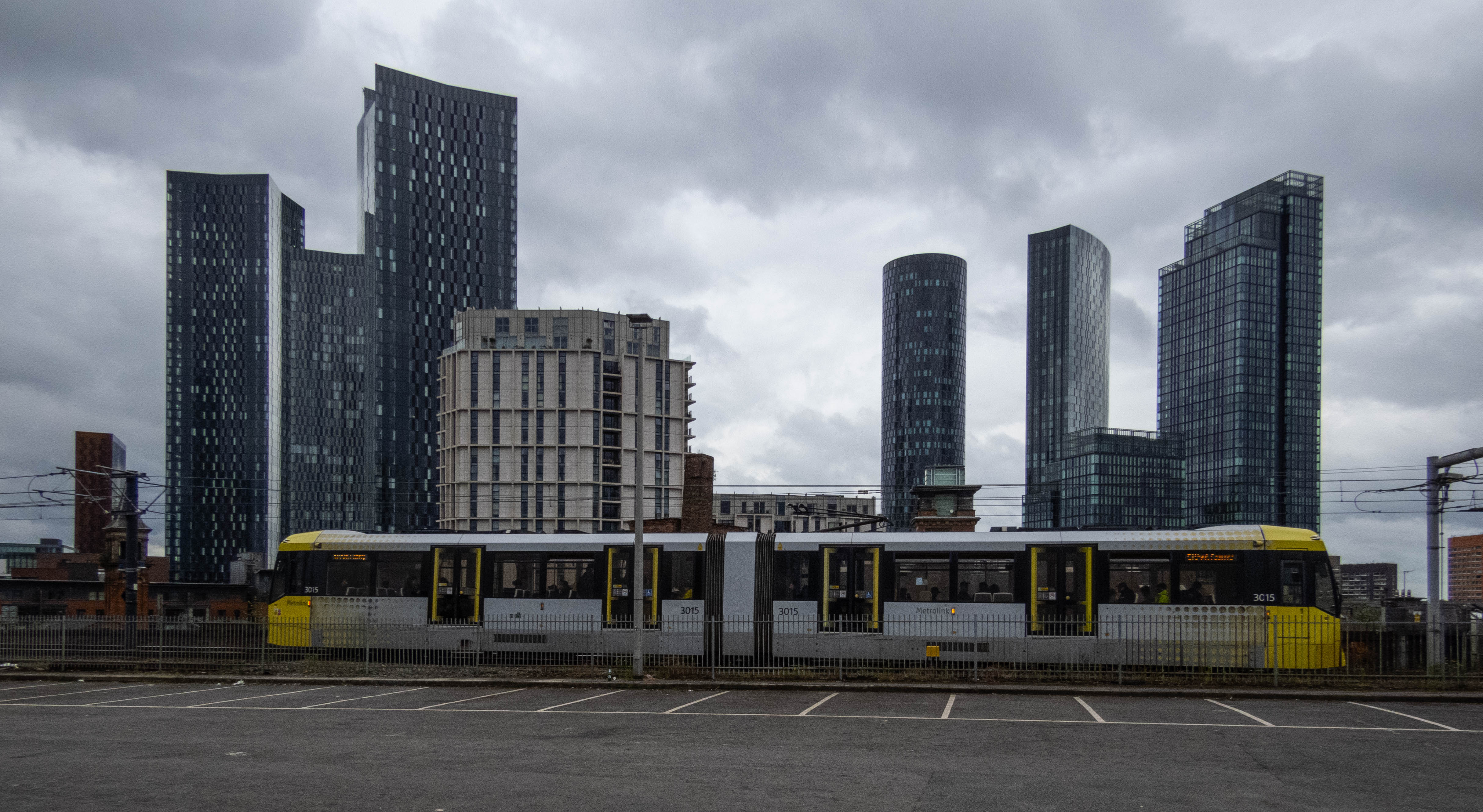
Manchester, England, UK
Walking Tours in Manchester with StreetLore
You're a Mancunian in your forties, grew up in Salford, walking next to a visitor. You take the city seriously but you don't over-sell it.
StreetLore is an audio walking companion that narrates the lore of Manchester as you walk or drive — origin moments, named-person episodes, era anchors, neighborhood mythology. Themes covered include victorian, civic, industrial, engineering, football, sport.
Popular spots covered in Manchester
6 hand-picked stops with researched narration. Every listing below ships with a curated lore beat — the same content the app speaks while you walk past.
 01
01Manchester Town Hall
historicA cathedral-sized Victorian town hall designed by Alfred Waterhouse, opened in 1877, built in a Gothic Revival style because Manchester was declaring — in stone — that it was as important as any medieval city. The Great Hall inside has the Ford Madox Brown murals, a series of 12 paintings that tell the city's history, starting with Roman soldiers founding Mamucium and ending with the Bridgewater Canal. The clock tower is 87 metres; the bell, called Great Abel, was cast at Whitechapel Foundry (same foundry that cast Big Ben and the Liberty Bell). Currently undergoing a multi-year restoration — if it's scaffolded, that's why.
 02
02Science and Industry Museum
museumHoused on the site of the world's first inter-city passenger railway station — Liverpool Road Station, which opened in 1830. The collection traces why Manchester mattered: steam engines that powered the cotton mills, the looms that made the cotton into cloth, the Baby — the world's first stored-program computer, built in 1948 at the University of Manchester and a direct ancestor of every computer alive today. The atmosphere room, where you can feel a 19th-century cotton mill running, is genuinely loud and a bit terrifying. Free entry.
 03
03Old Trafford
landmarkManchester United's stadium — 'the Theatre of Dreams', a phrase coined by Bobby Charlton in the 1990s — 74,000 capacity, the largest club ground in the UK. Opened 1910, bombed heavily in March 1941 during the Blitz (United had to play at City's old Maine Road ground for eight years while it was rebuilt). The statue outside of Matt Busby, manager during the 1958 Munich air disaster that killed eight of his young players, is a pilgrimage point; the Munich clock on the south-east corner of the stadium is another. Technically the ground is in Trafford, not Manchester — something United fans will tell you and City fans will tell you back, with emphasis.
 04
04Albert Square
squareThe civic heart of Manchester, fronting the Town Hall — named after Prince Albert, with his ornate Gothic memorial canopy at the centre, designed by Thomas Worthington and unveiled in 1867. The memorial was the first major Albert tribute in Britain, predating Hyde Park's. Statues around the square commemorate Manchester worthies — Gladstone, John Bright, Bishop Fraser, the chemist James Joule. The Christmas Markets cover the whole square through November and December; the rest of the year it's the staging ground for civic events, rallies, and protests. After the 2017 Arena bombing, it filled with flowers within hours.
 05
05The John Rylands Library
historicA neo-Gothic Victorian library on Deansgate, opened 1900, funded by Enriqueta Rylands in memory of her late husband John — a cotton magnate who owned more mills than anyone else in Lancashire. The building looks like a small cathedral because it was designed to make the reading of books feel like a spiritual act. The collection is serious: the oldest piece of New Testament text ever found (the Rylands P52 papyrus fragment, dated to around 125 CE), a Gutenberg Bible, letters from John Dee, Elizabeth I's astrologer. Free entry, quiet, very easy to lose an hour inside.
 06
06Chetham's Library
historicThe oldest public library in the English-speaking world, founded in 1653 in a sandstone building from 1421 that was originally a college for priests. Walk through the little courtyard off Long Millgate and you're in a place that hasn't materially changed in 370 years: oak bookshelves, leather-bound volumes on chains, a reading room with a single long table. Karl Marx and Friedrich Engels met here in the summer of 1845 and used this library to research what became the Communist Manifesto — you can sit at the exact table, by the bay window, where they worked. Free, open weekday afternoons, almost nobody finds it.
What StreetLore sounds like in Manchester
Below: the brand voice, in the voice notes the app uses for Manchester.
“Dry, direct, and quietly proud. Happy to call things daft. References to Mills, United vs City, the bees, the rain, the music scene are all fair game — used sparingly, not as postcard shorthand. Avoid 'Madchester'-era nostalgia unless the place earns it.”
Ready to walk Manchester?
StreetLore is a free download. Open it in Manchester and start walking — the lore lands as you pass each place.